Di Latchford, Training & Verification Manager at the British Institute of Cleaning Science, reports.
Have you ever stopped to ask yourself – 'How clean is that?'. In our daily lives, there is a lot of dirt on the surface that we can see, such as a build-up of dust or a spillage. But what about the dirt we can’t see on surfaces where it is not easy to spot? Sometimes dirt is especially hard to spot on darker or mottled surfaces.
I came across the very problem in my own home, I’d been preparing a pineapple on a chopping board in my kitchen, and the fruit was juicy and very messy. Once I’d finished and wiped everything down, I was happy with how the work surfaced looked. I say looked, as my surfaces are a dark grey marble effect, remember this, as the following is a tale of horror!
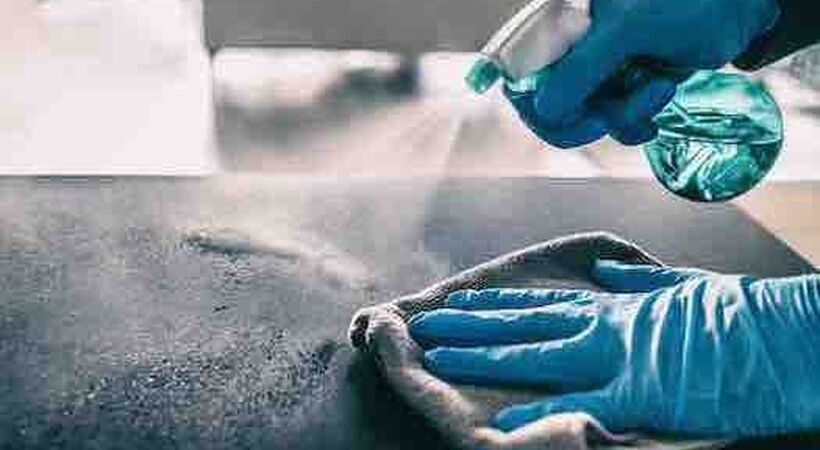
I did not use the work surface again until the following day when I noticed by touch that there was a stickiness to the surface. Remembering about the pineapple that I’d cut up yesterday, I recalled wiping the surface over and thinking to myself that couldn’t be the source of the stickiness. Wanting to blame one of my sons I theoretically donned my deerstalker hat, picked up my magnifying glass and proceeded to investigate like Sherlock Holmes. Imagine my shock though when I realised that although I’d wiped everywhere I may not have removed all the sticky residue. So, I grabbed a white disposable household multi-surface cloth and was perplexed when I’d finished and looked at the once white cloth to find it covered in grime. I’m not even sure that it was just the pineapple juice on the cloth. All sorts of bacteria could have been harbouring on that surface, as I mentioned before this was a surface I thought to be ‘clean’.
So, this gets me thinking, how clean is/was that surface, and why was it still dirty after my initial clean? Then the penny dropped! It was my technique that was wrong. Of course, I soon realised where I failed, I’d used the wrong cloth and the wrong product to clean the surface. In my haste to clear up, I’d carried out a sloppy incomplete task, hopefully I’m not alone in doing this.
So, what lessons have I learnt?
Appearances can be deceiving, however, I would suggest that you never suppose a surface to be clean merely by looking at it, this can be applied to any given scenario. How often have you looked at something and thought “It’s clean or that’ll do”?
If you are completing any cleaning task, do not try to skip corners it’s just not worth it and it may well land you in trouble or take you longer by having to redo a task. Always use the correct equipment and products for the task at hand. The BICSc standard for any task always ensures that you have the correct equipment for any task and your knowledge will determine the best product to use. Had I used a cleaning agent appropriate for the task and a microfibre cloth, using the BICSc method I’d been taught in BU5 Damp wiping, the overall result would have been much more effective, and the surface would have been both visibly clean and actually clean.
When does a quick wipeover ever do, when you are clearing up a mess?
Now I don’t want to make everyone feel obsessive about surfaces, that’s not my intention, but perhaps the next time you look at a surface you’ve cleaned, stop, and say to yourself ‘Is that clean?’
www.bics.org.uk
About the contributor

Di Latchford
Training & Verification Manager
BICSc